


Overview
The music industry has long been shaped by technological revolutions. From the advent of vinyl records to the rise of CDs and digital audio in the late 1990s, each innovation has transformed how music is created, distributed, and consumed. In the past decade, streaming services have again reshaped the landscape, democratizing access for emerging artists while raising questions about sustainability and income equity.
Now, artificial intelligence (AI) is emerging as the latest disruptor, poised to impact nearly every aspect of the music pipeline. From songwriting and performance to mixing, mastering, and even marketing, AI’s influence on music is growing rapidly. This article explores the expanding role of AI in music production, tracing its history, current applications, industry response, and the long-term implications of this rapidly evolving technology.
What is AI music?
Artificial intelligence refers to a broad category of technologies that use machine learning and data-processing algorithms to analyze patterns and generate new content based on large datasets. In the music world, AI has begun to position itself as both a creative collaborator and a productivity tool.
Many AI platforms aim to simplify or automate parts of the music creation process, reducing the technical barriers to entry and speeding up workflows. These tools are being adopted by everyone from independent artists to major labels, with companies forging partnerships with production houses, streaming platforms, and distribution networks. Both commercial and open-source AI tools are now available to the public, creating new opportunities, as well as new tensions, in the music industry.
AI-integrated music creation and distribution
AI is being incorporated at nearly every step of the music-making journey, from ideation to release. Here’s how AI tools are being used across the production pipeline:
Composition: AI music production tools assist with songwriting by generating melodies, harmonies, chord progressions, rhythms, and lyrics. Some platforms can even produce fully formed tracks based on user prompts or style inputs. Examples include AIVA, Udio, and Mubert, which use vast musical databases to generate original content in various genres.
Vocals: Advances in voice synthesis have enabled AI to generate entire vocal tracks, complete with emotion, tone, and stylistic nuance. Some tools, like ElevenLabs and Suno, can replicate the vocal characteristics of real artists, both living and deceased, raising creative and ethical questions about imitation and consent.
Mixing and Mastering: Traditionally complex and time-consuming, audio mixing and mastering are being streamlined with AI-powered tools. These systems can analyze frequency balances, apply EQ, compression, and noise reduction, and even complete entire mixes autonomously. LANDR and iZotope Ozone are two notable platforms leading the way in this space.
Marketing and Distribution: AI is also playing a significant role in music promotion and delivery. Record labels and distributors are leveraging AI for metadata tagging, rights management, and audience analysis. Streaming services like Spotify and Apple Music use AI to power recommendation algorithms, generate curated playlists, and even create interactive features like Spotify’s AI DJ, which personalizes listening experiences in real time.
How AI entered the musical landscape

The music industry has long been shaped by technological revolutions. From the advent of vinyl records to the rise of CDs and digital audio in the late 1990s, each innovation has transfor
AI in the music industry is not a new concept – in fact, it dates back decades. One of the earliest examples is the Illiac Suite (1957), a string quartet composed by Lejaren Hiller and Leonard Isaacson using algorithmic processes. These early experiments paved the way for a deeper exploration of AI’s creative potential.
In the 1980s, ambient music pioneer Brian Eno explored generative music, while academic projects like David Cope’s “Experiments in Musical Intelligence” pushed the boundaries of machine-generated composition. EMI could analyze a composer’s work and generate new pieces in a similar style, simulating the voices of composers like Bach and Mozart.
Modern AI-produced music saw a major leap forward with the launch of Google’s Magenta project in 2016. Using deep learning techniques, Magenta could generate music in a range of styles with a level of complexity previously thought to be unattainable. OpenAI’s MuseNet followed in 2019, capable of composing multi-instrumental pieces in diverse genres. These tools remain active and continue to improve as AI music technology evolves.
With the surge of AI development in the early 2020s, numerous startups entered the space, drawing substantial investment from venture capital firms. Today, new AI music technologies are regularly being launched, each one expanding the possibilities around artificial creativity, and with them – controversies.
Industry reactions to AI in music
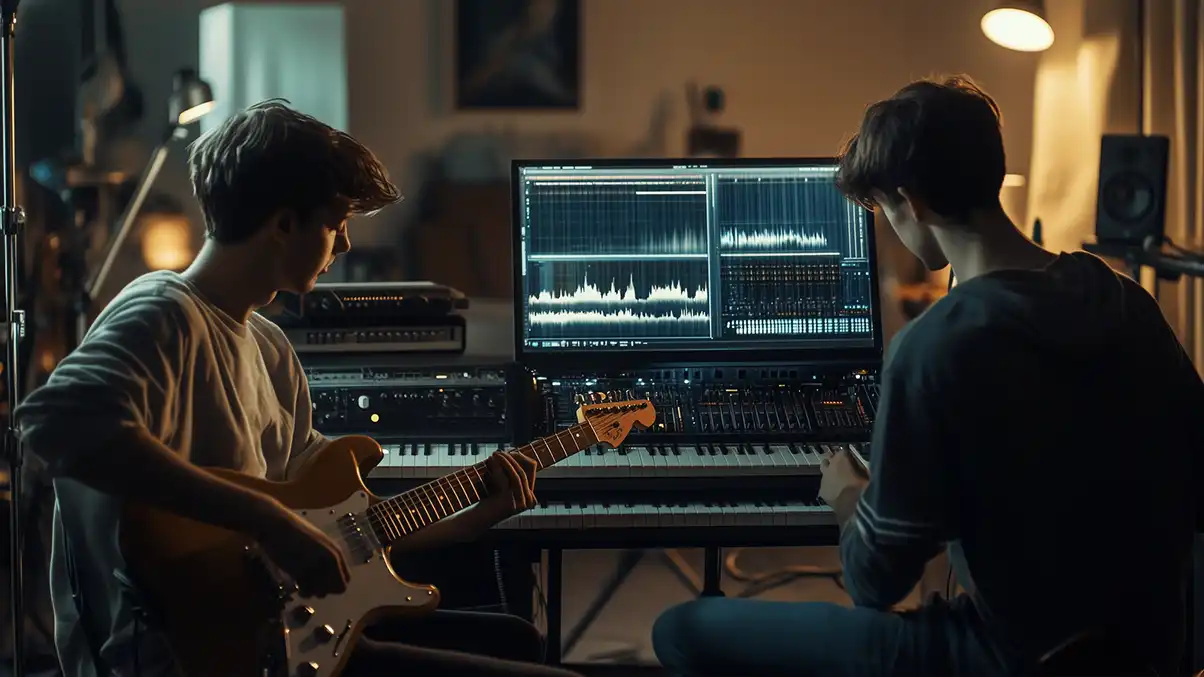
The emergence of AI in the music industry has sparked both excitement and concern. While some see it as a groundbreaking tool for democratizing music creation, others warn of its potential to undermine artistic value and erode professional opportunities.
Supporters argue that using AI in music production can eliminate many of the logistical and technical barriers that prevent aspiring artists from creating and releasing music. It offers a level of accessibility and support that can empower individuals with limited resources or technical training to participate in music production.
However, many critics contend that AI musical art lacks emotional authenticity, warning that a flood of low-effort, formulaic content could overwhelm the market and make it harder for human artists to stand out. In response, some musicians and organizations are actively promoting “human-only” music, celebrating the imperfections and spontaneity that come from human expression.
Ethical concerns have also arisen, particularly around the data used to train AI models. Most AI music technology is trained on vast libraries of copyrighted works, raising difficult questions about ownership, consent, and compensation. Should artists have the right to opt out of having their work used in training datasets? Should they be compensated if AI systems replicate their styles?
Major labels have taken these concerns to court. Companies like Universal Music Group, Sony, and Warner Music Group have filed lawsuits against programs that produce AI-generated songs, such as Suno and Udio, as well as against large language model companies like Anthropic. These legal battles focus on alleged copyright violations involving lyrics, compositions, and vocal likenesses. Some suits have been settled, but many are ongoing, with no clear resolution in sight.
The long-term impact of AI on music
As AI music production tools continue to evolve, the music industry must confront a host of unresolved questions. Will AI musical art be commercially viable in the long run? What legal protections, if any, will exist for AI-generated works? And how will listeners respond to music made without a human touch?
One major legal challenge stems from a U.S. court ruling that creative works produced entirely by AI are not eligible for copyright protection. This limits the ability of creators and companies to monetize and control AI-produced music, complicating distribution and revenue models.
As AI becomes more mainstream, the line between human and machine-made music is beginning to blur. Viral AI-written songs, sometimes falsely attributed to real artists like The Weeknd, have already confused listeners and raised concerns about authenticity.
The future of artificial intelligence in music will depend on both technological advancement and public perception. Some listeners may gravitate toward hyper-polished, algorithmically generated music – genres like hyperpop have already embraced digital artificiality. Others may seek out analog, imperfect, and deeply personal music as a counterpoint to the synthetic precision of AI tracks.
Ultimately, AI is likely to become a permanent fixture in the music industry, not as a replacement for human musicians, but as a tool that can either enhance creativity or challenge it, depending on how it is used.
Conclusion
AI is reshaping the music industry in real time. From songwriting and performance to mixing, marketing, and streaming, its influence can already be felt across the entire production pipeline – yet the long-term consequences remain uncertain.
As with past technological shifts, the music industry will adapt, but this particular transformation carries profound cultural and ethical implications. As we grapple with the role of AI in creative expression, music becomes a microcosm of broader societal changes driven by artificial intelligence. How we respond to these changes may shape not only the future of music but also the very definition of creativity itself.
FAQ
How is AI being used in music?
AI is involved in many stages of music production, from generating melodies and lyrics to assisting with mixing and mastering. It also powers the recommendation and discovery systems used by streaming services.
Is AI-generated music legal?
Yes, AI-generated music is legal, but exists in a gray area regarding its distribution. Because it often relies on copyrighted material during training, issues can arise, especially if the output imitates existing artists. DMCA takedowns have already occurred in such cases.
Will AI replace musicians?
AI won’t replace musicians, but it may become deeply integrated into music production. Human creativity, emotion, and performance are still central to music, and there will always be a demand for that authenticity.
Is there an AI that makes music?
Yes – several platforms like AIVA, Udio, Mubert, and Suno generate music using AI. These tools vary in complexity and use cases, from casual experimentation to commercial music production.
Can AI-generated music be detected?
Some detection algorithms can distinguish AI-generated songs from human-made ones with high accuracy, though not perfectly. As AI music technology improves, identifying synthetic music will become increasingly challenging.
