

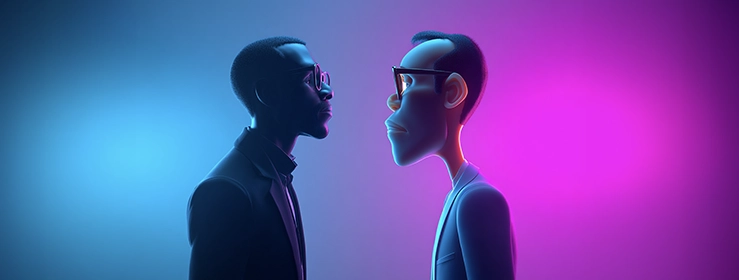
According to the 2024 report by TravelPerk found that 95% of people traveling for business would let an AI avatar represent them in a virtual meeting. More than half of the respondents also said they were open to delegating tasks like reminding them of deadlines or scheduling meetings to AI agents.
Professionals in a variety of fields are already seeing the benefits of AI avatars. This article will tell you everything you need to know about the difference between the two types of digital assistants, 2D and 3D avatars, before investing in an AI avatar solution.
A 2D Avatar and a 3D Avatar: What Are They?
Avatars are digital visual representations of individuals. They first appeared in video games and social media, where users can choose profile pictures or customize their characters to showcase a specific persona online. Even in these casual settings, avatars are seen as a way to influence the way you’re perceived.
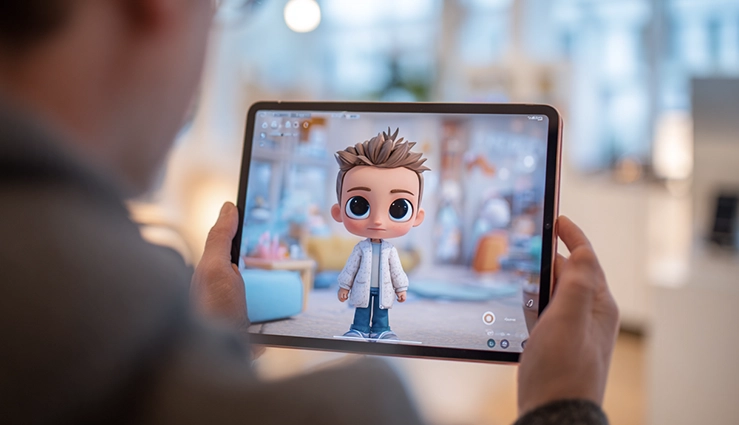
Once avatars became widely used in professional environments, where your brand’s positioning and reputation can significantly affect your success, this element became especially crucial. In addition to being a visual representative, businesses now use avatars as digital assistants for handling routine tasks.
There are two main kinds of avatars: 2D avatars and 3D avatars. 2D avatars are flat, two-dimensional designs. They might look like cartoon characters or realistic digital portraits. They can only move on a single plane and display animated facial expressions. The most well-known example of this type of avatar is VTubers. They use 2D animations to interact with the audience and express emotions without showing their faces.
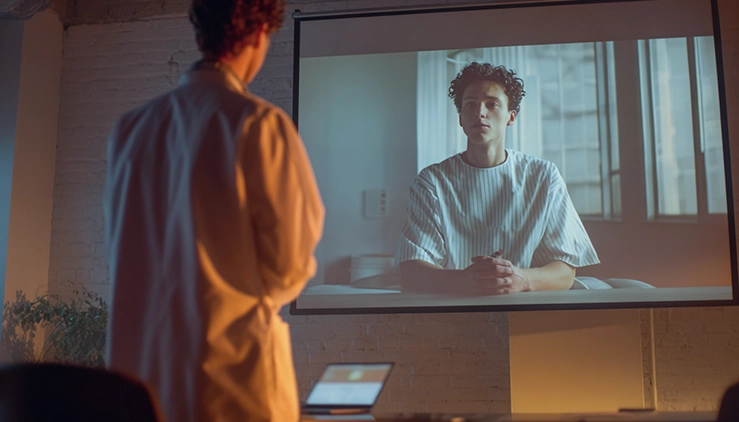
3D avatars go beyond simple illustrations. They are much closer to characters in video games or 3D animated films. Unlike flat drawings, they can be rotated, moved in any direction, gesture freely, and even interact with virtual objects and environments. Some avatars are realistic and look like actual human beings, while others are heavily stylized. 3D avatars are often used in professional settings where realism and human touch are necessary to establish a connection with the audience. For example, avatars can be used to simulate patient-to-doctor interactions during student and staff training sessions at medical institutions.
How Do 2D Avatars and 3D Avatars Work?
While the creation processes for 2D and 3D avatars have some similarities, they still require distinct technologies and design approaches.
2D avatars are generally designed using illustration and animation software such as Adobe Illustrator, Photoshop, or Live2D. Artists begin by sketching a base design and break it into individual elements that they want to animate, for example, eyes, mouth, hair, and clothing. These parts then go through a process called “rigging,” meaning a digital skeleton is created to control the movements of an object.
Facial expressions and mouth movements are often synced to real-time audio for live streaming or customer interactions. A user can also control the emotions on their 2D avatar face manually. This process is relatively quick and affordable, making it appealing for individual creators like YouTubers and Twitch streamers.
3D avatars require a more complex pipeline. They start with a 3D model created in software like Blender, Autodesk Maya, or ZBrush. The model is then sculpted with attention to shapes, details, and textures. Next, the avatar is “rigged” and brought to life by animation systems, which are often powered by AI or motion capture. This helps a 3D avatar move naturally: its gestures, walking, and even environmental interactions mimicking those of a real human being. For interactive VR environments, the avatars are optimized for real-time rendering in engines like Unity or Unreal Engine.
2D Avatar vs 3D Avatar Costs
The cost of creating a digital avatar varies significantly depending on whether it is 2D or 3D, as well as the level of detail, interactivity, and intended use.
2D avatars are generally more affordable. You can create a generic 2D avatar for free using open-source software and files. An experienced illustrator can make a base for a static avatar from scratch for a few hundred dollars. For custom-made animated 2D avatars, such as those often used by professional VTubers, expect to pay anywhere from $500 to $3,000.
3D avatars require more time and specialized expertise. A fully rigged, high-quality 3D avatar for professional or commercial use may cost between $2,000 and $20,000. The price will vary based on how detailed its design is and whether it needs full-body animations or motion capture. For enterprise applications, such as digital brand ambassadors or training simulations, costs can rise even further, particularly if they require complex animations, interactive features, or integration into VR/AR environments.
| Avatar Type | Cost Range (Basic) | Cost Range (Advanced/Professional) | Main Cost Drivers |
| 2D Avatar (Static) | Free – $100 | $300 – $700 | Illustration quality, unique style, licensing |
| 2D Avatar (Animated / VTuber) | $500 – $1,500 | $1,500 – $3,000+ | Rigging complexity, lip-sync features, custom animations |
| 3D Avatar (Basic Stylized) | $2,000 – $5,000 | $5,000 – $10,000 | Modeling detail, texture quality, basic animation |
| 3D Avatar (Photorealistic / Full-Body) | $10,000 – $20,000 | $20,000 – $100,000+ | Photorealism, advanced rigging, motion capture and AI integration, real-time performance |
AI Features in 2D Avatar vs 3D Avatar
Artificial intelligence plays an increasingly vital role in both 2D and 3D avatars, but how it integrates differs based on format and functionality.
When developing a 2D avatar, AI is mostly used for voice synchronization and animation automation. For example, with real-time lip-sync technology, streamers can move their animated 2D avatars while simply speaking naturally, without manual control. AI can also add emotion-driven expressions, automatically detecting speech tone and adjusting the avatar’s eyes, mouth, or gestures accordingly.
3D avatars, on the other hand, leverage AI for motion capture and interactive intelligence. AI-powered motion tracking systems can map a person’s body movements and facial expressions onto the avatar model, making them highly lifelike. Conversational AI models let 3D avatars produce natural speech, answer questions, or guide users through virtual experiences with spoken instructions. These features are essential for avatars used for VR customer service or as virtual brand ambassadors at industry events.
Platforms for 2D Avatar and 3D Avatar
The platforms where 2D and 3D avatars thrive reflect their core strengths and target audiences.
2D avatars are most commonly used in:
- Live streaming (YouTube, Twitch, TikTok Live). For example, VTubers and content creators interact with audiences via animated 2D personas.
- Customer service platforms where chat-based assistants use 2D representations to humanize support interactions (e.g., simplistic icons depicting human staff members)
- Social media branding for personal influencers and businesses seeking an approachable, stylized identity without the complexity of 3D (e.g., artist creators on YouTube representing themselves as cartoonish characters).
Platforms that often use 3D avatars include:
- Virtual and augmented reality (VR/AR), powering immersive training simulations, virtual meetings, and digital brand activations (e.g., a simulation of a real patient encounter in healthcare staff training)
- Gaming platforms and metaverse ecosystems, such as Roblox, Fortnite Creative, or Meta Horizon Worlds, where players or brands need fully interactive characters.
- Enterprise settings like virtual events, digital showrooms, and virtual production for films or advertisements.
2D avatars are perfect for situations when an accessible, fast-to-deploy solution is needed. 3D avatars are best fit for immersive and interactive experiences where realism and high-quality production are required.
Choosing 2D Avatar vs 3D Avatar
If you’re an independent creator or a small business with a limited budget, then a 2D is the solution for you. You can get 2D avatars for relatively cheap (or even for free, if you don’t care about originality), they’re easier to render, and their animation and deployment process is pretty straightforward.
If you need an avatar for an enterprise-level project, you’re better off working with professional 3D avatar developers. 3D avatars can be fully customized to reflect a business’s unique tone of voice and positioning. They look professional and polished both in apps and on kiosk and exhibition booth screens, delivering a seamless branded experience.
When integrated with AI tools, they can interact with users, answering their questions, simulating real-life situations during training sessions, and giving product introductions. Last but not least, 3D avatars can reach levels of realism that are simply impossible to recreate with only two dimensions.
| Criteria | 2D Avatar | 3D Avatar |
| Visual Style | Flat, stylized, often cartoon-like | Realistic or fully three-dimensional stylized look |
| Cost | Generally lower, good for budget-friendly projects | Higher due to modeling and animation complexity |
| Development Complexity | Can be designed and developed quickly for simple use cases | More comprehensive and complex modeling, rigging, and rendering |
| Interactivity | Limited; best for static or lightly animated content | Highly interactive; works well for gaming, VR, AR |
| Platforms | Streaming, social media | VR/AR, virtual and hybrid events, kiosks, interactive screens, etc. |
| Customization | Easier to iterate and modify, limited realism | Allows detailed realism and full customization |
| Use Cases | YouTube videos, avatar streams, independent content | Premium brand experiences, professional training, exhibition booths, kiosks, enterprise-level software, etc. |
Final Thoughts
Ultimately, the choice between a 3D avatar and a 2D avatar will depend on your business objectives, needs, and budget. Whatever your final decision will be, it’s important to choose the right service provider. If you’re looking for experts in creating 3D AI-powered avatars of various complexity levels, Digital Residency is here to help.
FAQ
What’s the main difference between a 2D avatar and a 3D avatar?
The main difference between a 2D avatar and a 3D avatar is that the former is a two-dimensional image, while the latter is a fully rendered three-dimensional model.
Which is cheaper to create: a 2D avatar or a 3D avatar?
A 2D avatar is cheaper to create because it’s easier to sketch, animate, and integrate.
Do 3D avatars require more powerful hardware than 2D avatars?
3D avatars don’t necessarily require more advanced hardware than 2D avatars. They can run on anything, from personal tablets to large exhibition booth screens.
Which avatar type is better for customer service applications?
AI-powered 3D avatars offer a more human-like and personalized user experience than 2D avatars do, making them perfect for customer service apps.
Can 2D avatars be converted into 3D avatars using AI?
While there are indeed AI tools that can convert 2D images into 3D models, human intervention is still necessary for an avatar to function properly.
Which industries benefit most from 3D avatar technology?
Industries like healthcare, banking, event organization, and real estate can use 3D avatars to enhance training sessions, reduce workload, and increase the number of quality leads.
