


Healthcare events remain one of the most important ways to engage healthcare professionals (HCPs). In-person meetings such as conferences, exhibitions, summits, and brand events continue to play a key role in professional education, peer exchange, and the discovery of new therapies.
However, the reality surrounding these events is changing rapidly. HCPs are busier than ever, attention is harder to earn, and event budgets are under constant pressure. Marketing teams at medical companies — and the agencies supporting them — are increasingly being asked the same question: What real value did this event deliver?
Traditional booth strategies are struggling to keep up. Printed brochures, looping slide decks, and generic digital screens no longer stand out in crowded event spaces. When HCPs have limited time, they expect interactions to be relevant, personalized, and genuinely useful.
As a result, healthcare brands are rethinking how event experiences are designed. Interactive, data-driven formats are becoming the norm, with conversational AI avatars emerging as a central engagement layer. These avatars make it possible to scale expert interactions, deliver high-quality scientific content, create real-time engagement, and measure actual value instead of simply counting interactions.
Let’s explore how pharmaceutical and biotech companies can use AI avatar-led experiences, alongside formats such as virtual reality (VR) and gamification, to create healthcare event experiences that truly connect and perform.
What Are AI Avatars for Healthcare Events?
AI avatars are interactive virtual characters powered by artificial intelligence. At healthcare events, they act as conversational interfaces that can answer questions, explain therapies, guide users through scenarios, and adapt conversations based on who they are speaking with.
AI avatars solve several common event challenges at once. They cut through attention overload by creating interactive moments that invite participation rather than passive viewing. They help brands stand out visually and experientially, and they shift spending away from low-impact activations toward experiences that generate real, measurable insights.
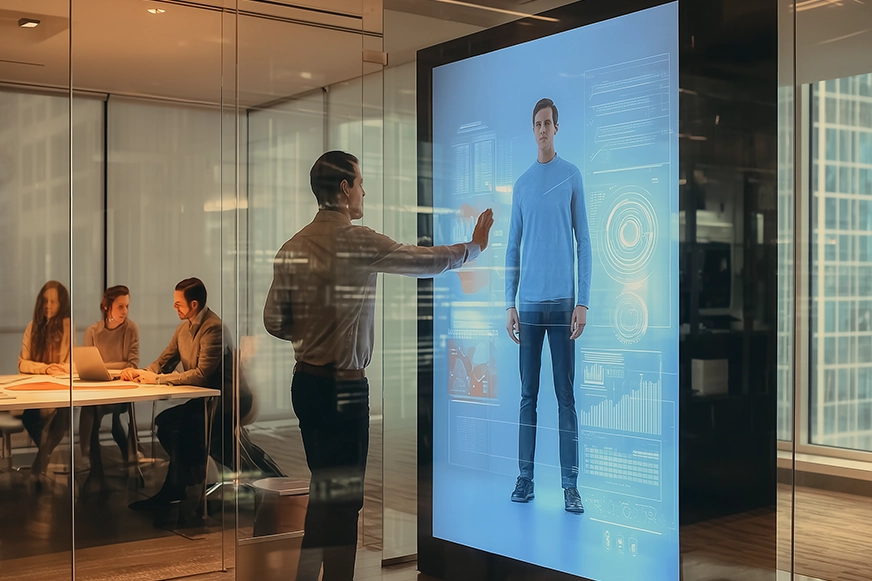
Three Main Types of AI Avatars for Medical Events
Interactive Screens
Interactive AI avatars are among the most effective “phygital” event solutions available today. Not only do they attract attention thanks to their distinct appearance among traditional booth setups, but they also provide experiences that can’t be achieved through conventional means.
Unlike human booth staff, AI avatars don’t get tired or forget key information. And unlike printed brochures or looping pre-recorded videos, they are far less likely to be ignored. Instead of passively receiving sales messages, visitors become active participants in a guided learning experience.
Medical Holograms
Holographic displays for medical conferences, exhibitions, and other kinds of events have gained popularity as an eye-catching way to lure in booth visitors. Interactive avatars, which are often referred to as medical holograms, are typically integrated into Holoboxes.
Due to their futuristic appearance, which usually takes the form of a human-sized display box, this format is often used by exhibitors aiming to position themselves as innovative and forward-thinking.
Fully Digital (Websites and Apps)
AI avatars are not limited to physical booths or offline events. A virtual AI human can be an effective virtual medical conference engagement solution. For example, it can deliver a presentation while reinforcing tech-forward branding and serving as an attention-grabber in an environment like a virtual event, where attention is more difficult to capture and hold than ever.
Additionally, integrating an interactive avatar on the landing page of a website or app can significantly improve the customer experience. Virtual visitors often feel more welcomed when there is a human-like presence guiding them, answering questions, and helping them navigate features.
Pros of Interactive Avatars at Medical Exhibitions
We’ve covered the main types of AI avatar formats companies use to generate real value from event participation. Now let’s look more closely at what these virtual humans can help healthcare brands achieve at medical events.
They improve expert accessibility without overloading teams
At healthcare events, expert time is always limited. It’s simply not realistic to expect medical or therapy-area experts to speak with thousands of HCPs over a few days while maintaining the same depth, consistency, and energy.
An AI avatar acts as a support layer that extends expert access without burning out teams. It delivers brand-approved messaging consistently and stays focused throughout the event. This allows human experts to concentrate on the most valuable and complex conversations, while routine questions and foundational education are handled effectively at scale.
They extract meaningful insights from every interaction
One of the biggest limitations of traditional event booths is the lack of actionable insight they generate. AI avatar interactions change this entirely. Every conversation produces data.
Teams can see which topics HCPs care about most, where questions or skepticism arise, how long engagement lasts, and which content resonates. While traditional metrics like badge scans, footfall, and post-event surveys show reach, they reveal little about real engagement or impact.
AI avatars serve as always-on conversational touchpoints that collect consistent, comparable data across audiences and event days. They make it possible to understand engagement in depth, identify which narratives hold attention, and detect early signals of intent through follow-up requests or repeat interactions.
They are always compliant
In healthcare, interactivity only works if it remains compliant. Modern AI avatar platforms are designed with regulation in mind, incorporating secure data handling, consent management, and strict adherence to privacy standards.
Responses are generated from pre-approved, MLR-reviewed content libraries. Conversations follow structured logic with clear guardrails, redirecting off-label questions appropriately. Every interaction is logged, ensuring transparency and auditability while enabling engaging avatar experiences without compromising compliance.
They provide personalized experiences
Using artificial intelligence to elevate visitor experience at in-person events is nothing new. AI avatars take that to another level, combining engaging visuals with conversations that automatically adapt to different specialties by adjusting terminology, depth, and clinical context. As interactions progress, they learn what each HCP is interested in and prioritize relevant content accordingly. Avatars can also retain context from previous conversations, applying accumulated knowledge across events and platforms to support long-term relationship building with thousands of HCPs simultaneously.
They keep audiences engaged before, during, and after the event
Healthcare events are no longer confined to what happens on the show floor. Before the event, HCPs can explore virtual previews, interact with an avatar online, and book time to dive deeper into specific topics. Short avatar-led videos can introduce key ideas and spark early interest.
During the event, AI avatars in physical interactive kiosks or as medical holograms anchor the live experience, while integrated scannable QR codes allow interactions to continue afterward. Virtual access options also help manage peak traffic and reduce wait times.
After the event, engagement continues. A familiar avatar can welcome returning HCPs, pick up previous conversations, and provide on-demand access to content long after the event concludes.
They qualify leads and support follow-up
As AI capabilities evolve, avatar solutions are moving beyond engagement into predictive intelligence. During interactions, they analyze signals such as question complexity, time spent, scenario completion, and follow-up requests.
This data helps prioritize leads, predict prescribing or trial enrollment potential, and guide sales and medical teams toward the highest-value opportunities. Over time, systems learn which behaviors lead to real-world outcomes, making future targeting even more precise.
Conclusion
Interactive AI avatar and immersive VR experiences, gamification, and always-on digital engagement platforms are becoming standard components of modern event strategies.
Healthcare brands are increasingly seeking stronger links between event investment and real-world outcomes. Conversational AI avatar solutions support expert-level scientific exchange, maintain continuity across multiple events and platforms, and operate at a scale that traditional formats simply cannot achieve.
Industry events offer healthcare companies the opportunity not just to increase visibility but to build meaningful relationships, generate high-quality leads, and engage directly with their target audiences. To maximize the value of event participation, it’s essential that no booth interaction goes unrecorded.
Still unsure whether AI avatars are the right solution? Looking for research-backed evidence of their impact? Explore our 2026 avatar trend report, where we break down everything you need to know about implementing AI avatars at medical congresses.
FAQ
What types of healthcare events can an AI avatar be used at?
AI avatars work well across a wide range of healthcare events, including conferences, exhibitions, medical meetings, brand activations, advisory boards, and hybrid or virtual events. They can be deployed at physical booths, on tablets or kiosks, through QR codes, or as fully online experiences, making them flexible enough to support almost any event format.
Are AI avatars meant to replace human experts at events?
No. AI avatars are designed to complement human experts, not replace them. They handle high-volume, repeat questions and foundational education, freeing medical and commercial teams to focus on deeper, high-value conversations where human expertise is most impactful.
How do AI avatars stay compliant in regulated healthcare environments?
Healthcare-focused AI avatar platforms operate within strict compliance frameworks. They use pre-approved, MLR-reviewed content, follow structured conversation logic, and include guardrails that redirect off-label or inappropriate questions. All interactions are logged, creating full transparency and audit trails for medical and legal teams.
Can AI avatars personalize conversations for different HCPs?
Yes. AI avatars can adapt conversations based on specialty, interests, and interaction behavior. Over time, memory-enabled avatars can recognize returning HCPs, continue previous discussions, and tailor content to match individual needs, creating a much more relevant and human experience.
What kind of data do AI avatars collect at healthcare events?
AI avatars capture engagement-focused data rather than simple volume metrics. This includes topics of interest, conversation depth, time spent, follow-up requests, and interaction patterns. These insights help teams understand what truly resonated and which interactions are most likely to drive downstream impact.
