

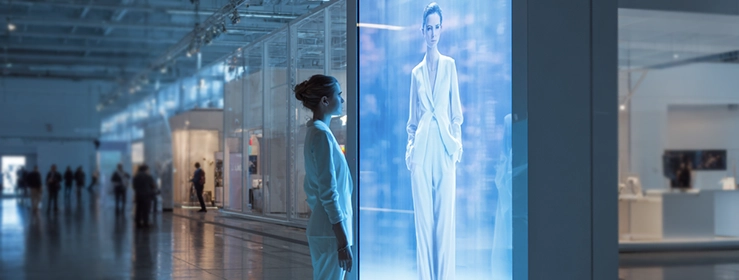
Who thought that the futuristic holograms from sci-fi movies would become a reality so soon? Today, holographic representations that look exactly like real-life humans are no longer just a fantasy — thanks to Holobox technology. Holobox is redefining how we interact with digital AI-powered avatars by using holographic technology to deliver ultra-realistic experiences. These systems use interactive holographics to bring virtual figures into the physical world without any other specialized gear.
With Holobox, the future of human–AI interaction is no longer confined to flat displays — it’s transitioning into three-dimensional space.
The Next Generation of Holographic Display Systems
3D Holobox technology helps present ultra-realistic holograms. Its main selling point? No VR headsets or any additional equipment are necessary: audiences can view and interact with the hologram box display through a 4K transparent LCD screen.
The name of this technology is straightforward: Holobox is a device that looks like a box with a white interior and a transparent screen in the front. It’s usually tall enough to fit a life-sized image of a person. 4K video resolution ensures holographic representations look realistic in practically any space. Thanks to built-in microphones and speakers, users can have live conversations with the AI avatars.
Whether you want to deploy a lifelike AI retail agent, deliver product demos via a hologram in a box, or engage customers with interactive holographics, we’ll design the right avatar solution for your application.
Compared to traditional screens or LED displays, the sense of realism is much stronger with Holobox. With LED technology, even the most realistic 3D images tend to look a little flat. With Holobox, holograms look as if they’re real people standing in a three-dimensional white room. This feature increases the memorability of events and, according to research, drives active audience engagement.
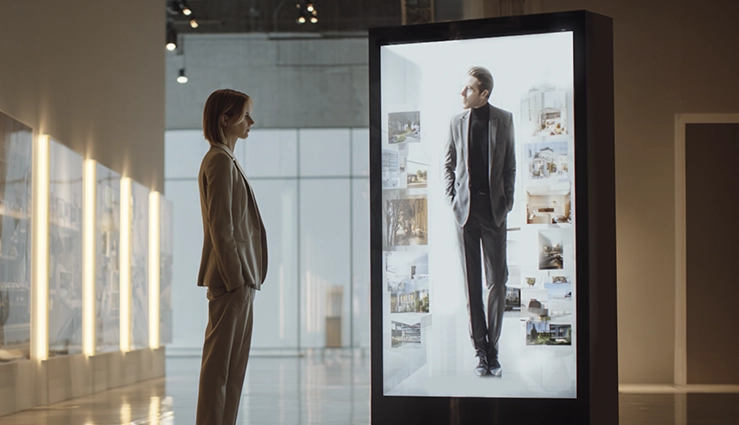
ChatGPT-Powered Digital Companions in Holographic Form
Down with assistant chatbots that lack basic natural language processing skills and get confused ones you slightly deviate from the pre-designed script. Conversational AI is currently the technology that fronts innovation in the virtual agent world.
The combination of ChatGPT’s natural language generation capabilities with interactive holographic display hardware results in immersive conversational experiences. Users can speak naturally to the holographic avatar, without worrying about it misunderstanding them. The avatar will respond verbally, complete with facial expressions and gestures. Unlike static videos or digital signage, ChatGPT-powered hologram avatars engage in two-way conversation. This means they can be highly effective during hotel check-ins, property tours, or even HR interviews.
In addition to real-time communication, holographic 3D avatars integrated with ChatGPT can also provide support in a variety of languages and adapt their tone based on context. Conversational AI-powered virtual assistants can also help efficiently resolve customer inquiries by redirecting any questions they can’t answer to human agents. This significantly reduces the workload on customer support staff while also improving communication efficiency.
Main Advantages of Holobox Display Solutions
Holobox offers immersive, flexible, and high-impact experiences that traditional display solutions simply can’t match.

Immersive Engagement
When audiences see a hologram box, they perceive the avatar displayed on it as a life-sized digital human right in front of them—not a flat virtual character. No screens, headsets, or touch interfaces are needed — users can interact with the avatar directly via the hologram box.
Real-Time AI Interaction
Thanks to ChatGPT integration, holograms can engage in dialogue with users and adapt their responses based on user input. For example, if an avatar is used as a customer support assistant, it will adopt a perfectly polished, customer-oriented manner of speech. It can also learn based on what the customer tells it about their preferences and suggest products and services based on that data.
Scalable Content
As your business grows, your Holobox AI avatar also has to adapt to the change. It’s incredibly easy to switch out avatars, languages, and scripts to match your new target audience or updated goals.
High-Quality Display
Your audience will be blown away by the quality of the 4K resolution image. The built-in audio and mic will enhance the realism and create a full-sensory experience.
Compact Design
Holobox devices are portable and come in a variety of sizes. Even if you only have a small corner on the exhibition floor, you can still install a hologram box. Holographic interactive display solutions also support custom branding, making them a perfect tool for your brand’s digital identity representation.
Industry Applications and Real-World Use Cases for Holographic AI Avatars
Holobox is already being adopted across industries for both functional and experiential purposes.
Hospitality
In hospitality, hologram AI avatars act as digital hotel concierges. Trained on local databases, they can perform check-ins and check-outs, deliver introduction speeches to guests, and even recommend activities and sights in the nearby area. In addition, they can also communicate in multiple languages, making sure visitors from all over the world can enjoy their stay at the hotel.
Retail & Events
In retail and event industries, AI avatars can serve as virtual brand ambassadors or consultants, greeting customers at the store entrance, introducing products, and offering suggestions based on previous purchase history. At events, they can help attract leads by delivering presentations and thorough product walkthroughs. An AI-powered assistant can be branded to match your business’s identity and positioning, making it an effective marketing tool.
Healthcare
AI avatars can be used to simulate real-life medical encounters to help train medical staff or students in a safe and controlled environment.
Education
In educational settings, Holoboxes can become powerful tools that increase knowledge retention and enhance overall education quality. One of the possible usage cases of this technology is life-sized projections of experts in various fields from all across the globe. Live presentations delivered through a 3D avatar display instead of a flat projection screen will help create an immersive learning environment and capture students’ attention.
FinTech & Banking
Banks can utilize holographic avatars to introduce clients to new offers and features. Digital agents can also verbally and visually guide users through simple operations like money depositing or withdrawal.
Holobox Investment Analysis: Cost-Effectiveness and Return on Investment
Holobox technology offers a compelling return on investment (ROI) through engagement, automation, and innovation. While costs vary by configuration and licensing, Holobox provides long-term value across several factors:
|
Category |
Benefit |
| Staff Replacement | Reduces labor costs with 24/7 AI presence |
| Lead Generation | Increases engagement at expos and events |
| Training Savings | Consistent delivery of onboarding content |
| Brand Value | Differentiates with cutting-edge image |
A single Holobox unit can optimize workflow, run multiple avatars on rotation, and provide consistent customer service 24/7. Businesses can expect both cost savings and competitive branding advantages over traditional kiosks or signage.
Conclusion
Holobox technology represents a leap forward in immersive communication by combining AI intelligence with cutting-edge holographic projection.
From customer service and retail to healthcare and banking, Holobox creates a new standard for how AI avatars can interact with people in the real world. Its compact design, high-quality visual output, and ChatGPT integration enable a range of applications that are both visually impressive and practical. As more industries embrace interactive holographics, now is the time to explore what a hologram box can bring to your customer experience, training strategy, or brand presence.
FAQ
What is a Holobox?
A Holobox is a self-contained holographic projection system that displays full-body avatars in lifelike 3D using transparent 4K screens and AI interaction.
How do AI avatars interact with users through Holobox technology?
They use microphones and ChatGPT to process speech in real time and respond via voice, gestures, and facial movement, creating an interactive, two-way conversation.
Can Holobox systems integrate with existing business infrastructure?
Yes. Holobox supports API and cloud integration, enabling connection with CRM tools, content management systems, and internal databases.
What industries benefit most from Holobox holographic AI avatar solutions?
Retail, hospitality, healthcare, and event marketing are top adopters due to Holobox’s ability to personalize and scale humanlike interactions.
What’s the difference between Holobox and traditional display screens?
Traditional screens are flat and visible. Holobox uses a practically invisible interactive screen for 3D holographic representations.
What is the cost of implementing Holobox technology for business use?
Pricing depends on deployment scale and customization. While upfront costs are higher than digital signage, ROI is achieved via automation, engagement, and brand differentiation.widespread.
How do you customize and train AI avatars for specific business needs?
Through avatar training modules, custom script uploads, voice profile selection, and branding options from service providers like Digital Residency.
