

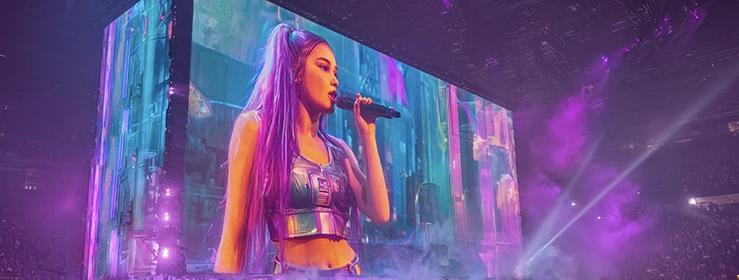
When you hear the word “hologram technology,” what comes to mind? For many, it’s an iconic moment in Star Wars when Princess Leia’s flickering 3D image delivers a desperate message. That scene, created decades ago, inspired an entire generation to imagine a future filled with holographic calls, concerts, and even teachers standing right in our living rooms.
Today, businesses, entertainers, educators, and even healthcare professionals are exploring the uses of hologram solutions to transform how we communicate and experience the world. As 3D avatars become increasingly common, it’s time for industry leaders to start exploring the benefits of holographic human technology. However, there are still misconceptions about what we mean when we refer to something as a “hologram.”
This article explores real hologram technology, its applications across industries, some holographic examples that have captivated audiences, and where holograms in the future might be headed.
What Is Hologram Technology?
When we talk about holograms, most people imagine a fully 3D image floating in space, perfectly viewable from all angles — a real-life hologram. Holography, in scientific terms, is the process of recording and reconstructing light fields using interference and diffraction, resulting in a 3D image visible without special glasses.
Hologram vs. “Pepper’s Ghost”
However, the reality of most “holograms” seen in virtual concerts or events is quite different. Instead of actual 3D floating images, they use a technique called Pepper’s Ghost — an optical illusion first popularized in the 19th century for stage magic.
Pepper’s Ghost works like this:
- A 2D image or video of a person is projected onto a transparent surface at an angle.
- The reflection creates the illusion of a 3D figure standing on stage.
- From the audience’s perspective, it looks like a person or object is physically there, even though it’s just a reflection.
This technique is more practical and affordable than true holography, which often requires complex laser setups and advanced optical materials. However, for simplicity, people still call these illusions “holograms” — and since the name has stuck, we’ll do the same here.
Industry Applications of Hologram Technology
Despite the technical limitations, holo technology is opening new opportunities across multiple industries:
1. Entertainment & Music
Holographic tech has changed how we experience live performances. Artists who are no longer alive, like Tupac Shakur, have been brought “back to life” on stage, allowing fans to experience something they never thought possible. Even living artists like ABBA are using real human hologram projections to perform without physically being present at the venue.
2. Corporate Events & Conferences
Holographic keynote speakers are becoming popular for global events. For example, a life-size real human hologram can appear at an industry trade show to give presentations, explain products to potential clients, and even interact with visitors thanks to AI integrations.
3. Retail & Marketing
Brands are experimenting with holographic displays to showcase products in interactive 3D form. Imagine walking past a store window and seeing a sneaker floating mid-air, rotating as if it’s physically there — but it’s just light. This not only could create an appealing, futuristic atmosphere and enhance brand visibility, but also be helpful at new product launches. Brand representatives could showcase an enlarged rotating 3D model of an item during presentations, so that it could be seen clearly from all angles, even in spacious venues.
4. Healthcare
Healthcare is adopting holo technology to create immersive learning experiences. Health care uses holographic tech to teach students about anatomy using a hologram of a human body. Holograms are also widely used in medical imaging: intricate holographic representations of human organs allow healthcare providers to get a more detailed understanding of the patient’s condition.
5. Education and training
Education is also finding creative ways to use hologram technology: for example, to give visitors a chance to get immersed in real historical events. Some museums showcase 3D holograms of historical figures in settings constructed with real artefacts, blending past and present for a unique experience.
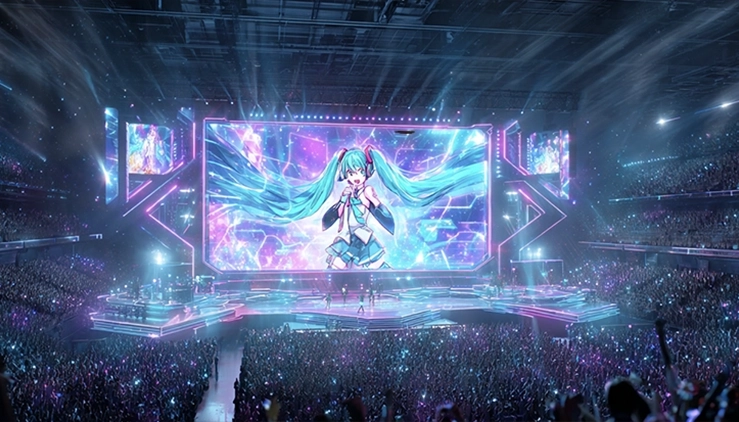
Three of the World’s Most Impressive Holograms
1. Tupac Shakur at Coachella (2012)
One of the most famous holographic examples ever took place at the 2012 Coachella music festival, where a digital recreation of the late rapper Tupac Shakur performed alongside Snoop Dogg and Dr. Dre.
This performance used the Pepper’s Ghost technique combined with advanced CGI to create Tupac’s likeness. Regardless of how the media outlets put it, it wasn’t a real-life hologram — in the sense that it was actually a computer-generated image projected onto a screen and no laser beams were involved. However, the event marked a turning point for how a real human hologram could be used to deliver unforgettable experiences.
2. ABBA Voyage Concert (2022 – Present)
The legendary pop group ABBA took holographic performances to the next level with their ABBA Voyage concert series in London. Audiences saw “ABBAtars,” digital versions of the group members from their 1970s prime, performing alongside a live band.
Using motion capture and cutting-edge projection technology, ABBA’s digital counterparts look stunningly realistic. This approach allows the band to “tour” indefinitely without physically performing night after night and opens up new opportunities for aging artists or those unable to travel. Both fans and critics agree that the ABBA Voyage show is the most realistic hologram performance in music history.
3. Microsoft HoloLens 2
Microsoft’s HoloLens 2 is an augmented reality (AR) headset that overlays holographic-like visuals onto the real world and lets people interact with them in real life. What users see through the AR headset glass is very similar to what holographic tech is portrayed as in the Iron Man movies. Businesses use HoloLens for design collaboration, engineering, and even medical surgery assistance. It represents a step closer to truly interactive, spatial holographic content and has demonstrated how mixed and augmented reality could transform a variety of industries.
Holographic 3D Avatars: Applications and Advantages
From Star Wars to Kim Possible, mainstream visual media played a huge role in placing an image in our collective consciousness of what holograms look like. The first thing that comes to mind when we think about hologram technology is characters in TV shows and movies talking to each other via futuristic devices. Smart objects that project human figures into reality captivated us back then. But now, we can actually live the technologically advanced future we only thought was possible in movies.
3D avatars usually appear on the screens of personal computers, interactive kiosks, and digital exhibition booths. But what if they could appear as if they were unrestrained by the limitations of a gadget? Holographic technology lets us create an illusion of full presence and immersion, creating an experience that beats regular flat images by a mile.
Applications of Holographic Avatar Technology:
- Virtual Meet-and-Greets: Celebrities and influencers can interact with fans without physically traveling, appearing as real human hologram avatars for photo ops and Q&A sessions.
- Customer Service & Business: A holographic concierge at a hotel lobby or a life-size virtual salesperson in a retail store can guide customers through product selections.
- Remote Team Collaboration: Executives and managers can present themselves as avatars in offices across the globe, enhancing remote work engagement using holographic human technology.
Advantages of Holographic Avatar Technology:
- Unlimited Scalability: A single avatar can appear in multiple locations at once.
- Reduced Organizational Costs: Eliminates the need for physical travel, reducing expenses and carbon footprint, and making events more accessible for individuals with mobility issues
- Enhanced Engagement & Novelty: People are naturally drawn to realistic, life-like holograms, improving user engagement and customer satisfaction.
The Future of Holograms
Holographic technology is still far from what we see in sci-fi films. For example, none of us have those portal-like gadgets that let you talk to a holographic image of your friend any time you want. But rapid advancements are pushing us closer to that vision. Here’s what we might see in the next couple of decades:
1. Real-Time Holographic Communication
Imagine taking a video call and seeing the person as a life-size hologram sitting across from you. Holographic technology companies like Cisco and Meta are already exploring future hologram technology for “holo-calls” using 5G and high-bandwidth networks.
2. Consumer-Friendly Home Holograms
Right now, holographic setups are expensive, bulky, and require special environments. Holograms in the future may include consumer-grade holo devices that you can carry with you anywhere. Yes, just like the imaginary bedazzled phone from that one Hannah Montana episode!
3. Fully Interactive Holographic Retail
Retailers could use interactive holograms that respond to customer gestures or even let customers “try on” clothes virtually using life-size, real human hologram models.
4. Holographic Education and Telepresence
Virtual classrooms with holographic teachers could make education accessible anywhere, allowing a single instructor to teach thousands of students in real time while feeling physically present thanks to holographic tech.
Conclusion
Hologram technology, whether it’s Pepper’s Ghost illusions or advanced AR-based systems, is rapidly evolving and shaping how we connect, learn, and experience entertainment. While we’re not yet living in a sci-fi-movie-style future where every device can project perfect 3D holograms, the steps we’re taking today — like holographic concerts, AR headsets, and lifelike avatars—show we’re moving in that direction.
For businesses, educators, and artists, holographic human technology offers new ways to engage audiences, reduce costs, and expand possibilities. And for fans of futuristic tech, one thing is clear: what once was science fiction is slowly but surely becoming science fact.
FAQ
What is hologram technology?
Hologram technology creates three-dimensional images using light diffraction to display objects that appear real and can be viewed from different angles without special glasses (in most cases).
Which technology creates holograms that you can interact with in the real world?
Interactive holograms use augmented reality (AR) and mixed reality (MR) tools like Microsoft HoloLens or systems from holographic technology companies such as ARHT Media, enabling gesture- and voice-controlled interaction.
How does hologram technology work?
It records and reconstructs light fields using lasers or digital projections. However, most entertainment events use the Pepper’s Ghost technique, which reflects images onto transparent screens to create a 3D illusion.
What is a hologram used for?
Uses of hologram technology include entertainment, education, telepresence, marketing, and healthcare imaging.
How much does hologram technology cost?
Small projectors cost $1,000–$5,000; event-scale holograms cost $50,000–$200,000+. Advanced interactive headsets like HoloLens start around $3,500.
How will holograms be used in the future?
Holograms in the future will include real-time holographic communication, virtual classrooms, real human hologram assistants, retail demos, and lightweight projecting devices as future hologram technology becomes cheaper and widespread.
