

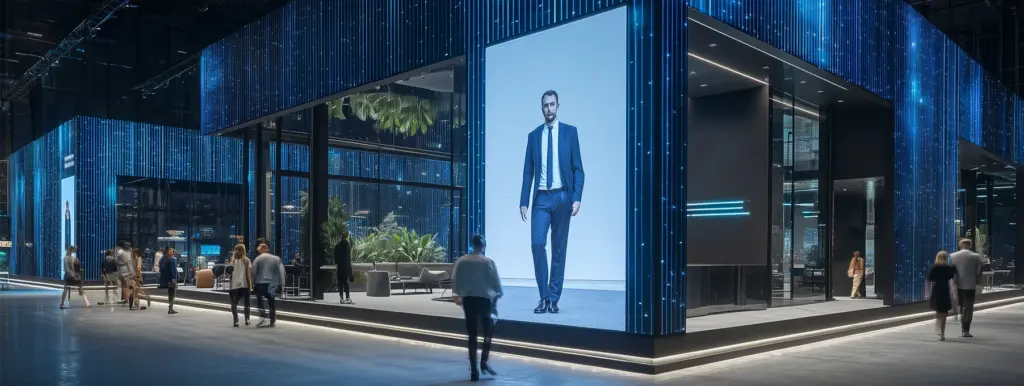
Trade shows and conferences present a unique challenge for exhibitors competing for attention in crowded exhibition halls. Traditional booth strategies struggle to engage attendees suffering from decision fatigue. AI avatars transform this dynamic by serving as tireless digital assistants that consult, qualify, and capture leads automatically. Virtual humans work 24/7 without breaks, delivering consistent brand messaging while freeing human teams to focus on closing high-value deals.
Best Types of Avatars for Events
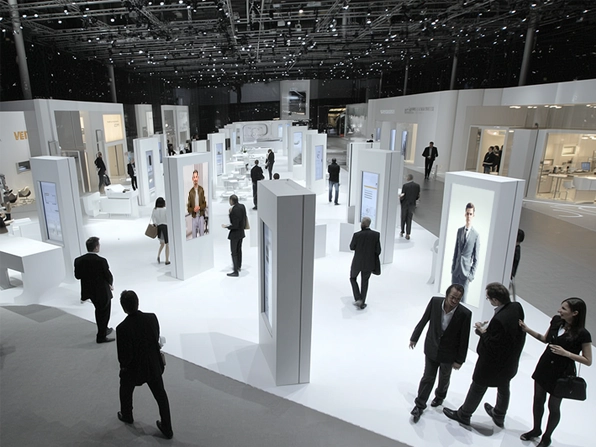
Digital Residency creates five specialized avatar types for different event objectives. Each avatar combines motion capture animation, natural language processing, and brand-aligned personality design. The platform deploys across holoboxes, kiosks, mobile apps, and VR headsets with seamless CRM integration. Here are the best avatars for events that companies use to dominate trade show floors.
Brand Ambassador Avatar
Brand ambassador avatars serve as your digital spokesperson at product launches and corporate events. These fully customized avatars feature photorealistic visuals from professional motion capture, multilingual capabilities for international audiences, and interactive storytelling that adapts to visitor questions.
At CES and NRF, exhibitors position brand ambassador avatars on large displays or holoboxes to create immediate visual impact. The avatars greet visitors, share origin stories, and guide product demonstrations while collecting contact information. Unlike human staff who need breaks, these avatars deliver enthusiastic messaging with equal energy throughout the event.
Best for: Product launches, brand awareness campaigns, corporate sponsorships at major conferences.
Lead Qualification Specialist Avatar
Lead qualification specialist avatars conduct strategic discovery conversations for B2B environments where deals exceed six figures. These avatars assess prospect fit through questioning about company size, current solutions, pain points, and purchasing authority. The system scores each lead and alerts human reps when high-value prospects are discovered.
Context-aware conversation flows remember earlier statements and ask relevant follow-ups. CRM integrations direct data into Salesforce, HubSpot, or Microsoft Dynamics during conversations. Companies report that AI can save over 20 minutes per prospect on research and follow-up.
Best for: B2B trade shows, enterprise sales conferences, networking events with six-figure deal potential.
Product Expert Avatar
Product expert avatars present complex technical information for complex solutions in a more easily digestible way. These avatars draw information from the company’s knowledge bases, covering product specifications, use cases, competitive advantages, and implementation processes. They can also hold iInteractive product demonstrations and walk visitors through essential features.
At healthcare conferences and technology expos, product expert avatars have to process technical questions from knowledgeable audiences. These virtual representatives can be trained on extensive FAQs, answering hundreds of questions based on relevant product documentation. When queries exceed the avatar’s scope, they connect prospects with human specialists.
Best for: Complex technical solutions, SaaS demonstrations, healthcare innovations requiring detailed explanation.
Event Navigator Avatar
Event navigator avatars help attendees find their way at large conferences spanning multiple halls or buildings. These avatars integrate with venue mapping to provide directions to specific booths, session rooms, and amenities. When integrated with a scheduling or event management software, they can also notify attendees of upcoming keynotes and workshops.
Event organizers deploy Navigator avatars at registration areas, main entrances, and food courts. Attendees interact via kiosk touchscreens or mobile apps, receiving guidance without information desk queues. Sponsor recognition features highlight partner booths, creating additional revenue opportunities.
Best for: Large-scale multi-day conferences, expo venue wayfinding, attendee experience enhancement.
Entertainer Avatar
Entertainer avatars create memorable brand experiences that generate social media buzz. These avatars can hold spontaneous, humorous, personality-driven conversations and host i. Interactive games, challenges, trivia contests, scavenger hunts, and product giveaways.
At consumer expos and brand activations, these avatars draw crowds that can significantly extend booth dwell time. Thanks to their engaging personalities being paired with advanced technology, they leave a lasting impression on all guests. Those, in turn, tell their colleagues about their experience, drawing even more people to the booth.
Best for: Brand activations, experiential marketing, consumer-facing events prioritizing social reach.
Best Avatars for Conferences: Deployment Options
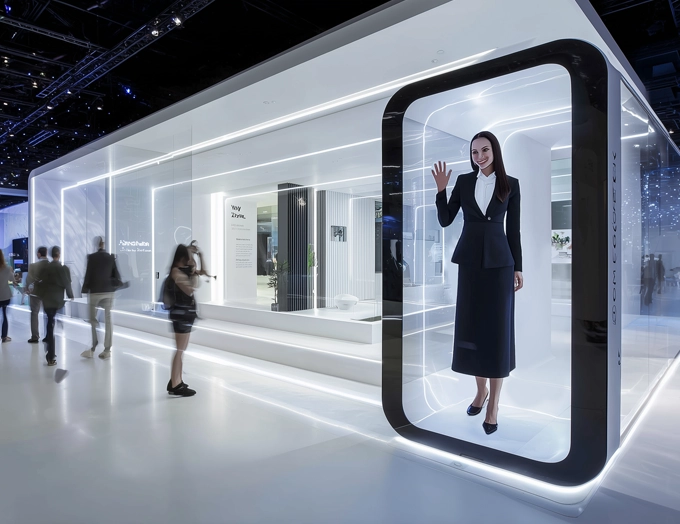
Avatars for events can be deployed across multiple formats depending on budget and visual impact requirements. Holobox integrations create three-dimensional projections in glass chambers, kiosk installations use large touchscreens, mobile integration embeds avatars in event apps, and VR experiences offer full immersion. Companies achieve optimal results by combining formats — holoboxes for traffic attraction and mobile for extended engagement.
| Format | Features | Usage |
| Holobox | Interactivity, realism (an illusion of presence) | Stands out in high-traffic halls |
| Kiosk/Screen | Interactive, comes in many different shapes and functionality combinations | Budget-conscious, great for offline events |
| Mobile/Web | Scalability, portability, limited access in offline mode | Great for hybrid events |
| VR Headset | Immersive, interactive, not limited to a screen | Lets clients interact with a product before buying it and explore it in detail |
Holobox Installations
Holobox installations display life-sized avatars on screens covered with glass.
Implementation of a holobox usually requires 4×4 feet of floor space and a standard power supply. While this option might be on the pricier end, many exhibitors agree that the improved attention levels and lead capture effectiveness make it worth it in the long run.
Kiosk & Touchscreen Stations
Kiosk displays are a less costly option in comparison to holoboxes. While they don’t provide the same realism, they still provide a user experience that is engaging enough to compensate for it. On average, multiple stations can handle 200-400 conversations daily during peak hours, with the queue management feature keeping attendee frustration at bay.
Some kiosks have touchscreens to accommodate noisy environments and people with hearing impairments, while others react to voice commands.
Mobile App Integration
Avatars can also be embedded into event apps, which attendees can access from their smartphones. This extends engagement beyond booth hours, making pre-event research and post-event follow-up easier. Mobile apps also let virtual attendees at hybrid events access the avatar experience.
This option usually has the lowest implementation costs because it doesn’t require specialized hardware to be shipped to venues.
Virtual and Augmented Reality Experiences
Virtual and augmented reality experiences create fully immersive avatar interactions via headsets. Product demonstrations benefit from 3D visualization and interactive features, particularly for complex machinery, architectural designs, or software interfaces. Microsoft showcased in their commercial exactly how an AR headset can be used to navigate scenarios that require precision and don’t allow room for mistakes.
Since VR and AR headset sessions typically last for around 3 to -5 minutes due to comfort limitations, rotation management is required during peak traffic hours. Dedicated staff should assist with headset setup and monitor users for safety.
Real Success Stories with Event Avatars
These implementations prove that avatar technology delivers across medical, defense, and B2B sectors.
DCK 2024 Medical Congress
Event organizers at DCK 2024 medical congress in Germany deployed 2D AI avatars on tablets throughout the venue. The avatars helped attendees navigate schedules, locate speaker sessions, and learn about exhibitors. Over three days, avatars handled thousands of interactions while reducing strain on information desk staff.
Attendees interacted with the VR avatar via the Meta Quest 3 headset. While the exhibition hall was incredibly crowded and loud, the advanced sound technology succeeded at blocking out background noise, ensuring the interactions between users and the avatar went smoothly.
AVANT Special Forces Summit 2024
RAVATAR showcased an AI keynote speaker avatar at the AVANT Special Forces Summit.
It was a virtual copy of Ian Kieninger, CEO of AVANT. The human presenter had a lively conversation with his digital twin right on the stage. Over 2000 attendees also interacted with the avatar during the summit.
Enterprise Technology Expos
Across CES, AI & Big Data Expo, and SaaS conferences, exhibitors deploy interactive avatars as a “first point of contact” strategy. Avatars positioned at booth entrances greet attendees, conduct qualification conversations, and lead high-value prospects to human reps.
Why do avatars work so well as virtual doormen? This is due to their innate qualities:
- Many are still new to the interactive avatar technology. Even if they’re not interested in your product yet, they might stop for the avatar.
- A human-like avatar with a welcoming expression on its face will make any guest feel comfortable at your booth.
- Avatars integrated with management systems can handle the entirety of the lead qualification process.
Choosing Your Avatar Strategy
Event type, booth size, budget, and lead volume goals will determine your optimal avatar strategy. Consider these critical factors when planning deployment:
- Event type and audience expectations
B2B technology conferences might benefit from product expert avatars handling complex technical questions. Consumer expos can use entertainment avatars to create opportunities for shareable social moments. Healthcare events require avatars with medical terminology and regulatory compliance knowledge.
- Booth footprint and traffic patterns
Large booths spanning over 20×20 feet can accommodate multiple specialized avatars at the entrance, center, and qualification zones. For medium 10×20 booths, two avatar stations handling different visitor segments should be enough. Small under 10 square feet booths can maximize impact with a single avatar adapting to the prospect’s needs.
- Lead volume versus relationship depth
Exhibitors targeting 500+ qualified leads require an avatar-driven capture strategy with multiple stations. Events prioritizing executive relationships use avatars for information delivery and warm handoffs. Enterprise companies balance both approaches with avatars pre-qualifying before connecting high-value prospects to specialists.
- Staff availability and expertise
In situations when booth personnel are limited, exhibitors can rely on avatars for managing high-traffic periods while human reps focus on qualified prospects. Large sales teams use avatars as force multipliers that pre-educate visitors. Technical launches benefit from avatars handling FAQs, so engineers can concentrate on advanced demonstrations.
Final Words
Exhibitors across domains and industries use AI avatars to capture more leads, qualify them more effectively, and close deals at significantly higher rates than when using traditional booth strategies. With only 6% of exhibitors confident in event lead conversion, avatar technology provides an immediate competitive advantage. While competitors struggle with booth traffic chaos and manual qualification, exhibitors leveraging avatars operate efficient, data-driven lead generation machines that work 24/7 without fatigue.
The future of event marketing augments human connection with intelligent technology. Best avatars for conferences handle repetitive qualification tasks flawlessly, allowing sales teams to focus on building relationships and closing deals.
Ready to dominate your next trade show? Digital Residency’s solutions transform booths into must-see experiences that capture, qualify, and convert prospects into revenue.
FAQ
What industries benefit most from AI avatars at events?
AI avatars deliver value across B2B technology, healthcare, financial services, manufacturing, and enterprise software sectors. Any industry where qualified lead generation is the main goal of event participation benefits from avatar deployment.
How do AI avatars qualify leads differently from human staff?
AHuman staff apply consistent qualification criteria to every conversation, asking identical discovery questions and scoring responses using predefined parameters. Avatars do all that — but much quicker. In addition, they can assess company size, budget indicators, purchasing authority, timeline, and pain points without bias or fatigue in mere minutes with the help of AI. Thus, human staff receive only pre-qualified prospects meeting specific criteria, allowing them to focus on high-value conversations. The system also logs complete conversation transcripts for the sales team to review.
Can avatars speak multiple languages at international events?
Avatars can support multilingual conversations. The avatar detects attendee language preference through initial greeting or manual selection. Qualification data and conversation transcripts translate automatically in your CRM. This capability is especially valuable at international conferences with attendees coming in from all over the world.
How many conversations can one avatar handle simultaneously?
Single kiosk installations handle one conversation at a time with digital queue management for waiting attendees. Mobile deployments support unlimited simultaneous conversations since each attendee uses their own smartphone. Companies targeting high volume typically deploy multiple kiosk stations.
